Thursday, September 20, 2012

Afternoon Tea at Alberton


There’s a new book on the block, and it’s all about me, heaps of other people — and more importantly, 200-plus chickens. Urban Chicks has profiles by Renée Lang with photos by Trevor Newman, and I’ve contributed a sprinkling of hen-keeping hints at the back.

The only appropriate way to celebrate such an initiative is with a hen party, so that’s what happened. On a fine spring afternoon at Alberton, one of Auckland’s finest historic properties, invited guests roamed the Mt Albert house and grounds, heard pianist Billy Farnell tickle the ivories, bid for chicken-related items in a silent auction, sipped tea from fine china cups, and sampled a spread of Renée’s superb home baking. 

We were a mixed bunch, from Pat and Lovest Reynolds who’ve kept hens in Howick for half a century (all their flock are named Katie) to the family who called in with Cocoa, their special-needs bantam (geriatric and blind), on their way home from a weekend at the beach. And a former Mr Gay Auckland, MP David Cunliffe, financial advisor Greg Moyle, food writer Julie Biuso. Yes, they all have chickens in their backyards too. 

I won’t begrudge David Cunliffe the hand-painted teapot (starring chickens!) that he scored in the silent auction: he simply outbid me. Nor will I hold it against fiction publisher Harriet Allan that she won the coveted Grandpa’s Feeder (a clever ‘help yourself’ device for hens) in one of several raffles — I didn’t really need it. 

The proceeds from those fundraising activities are going to a north-of-Auckland charity that finds homes for downtrodden chooks and other hitherto unlucky creatures. The owner of the Animal Sanctuary attended the launch in a wheelchair, as the previous week she’d broken her ankle in the line of duty, during a rescue. 

Alberton, owned by the Historic Places Trust and managed by chicken-keeper Rendell McIntosh, was a fitting venue. The ballroom, which is smaller and more intimate than the anonymous expanses at today’s five-star hotels, easily accommodated all of us for the speeches, and doubled as a gallery for an exhibition of art by another chicken-keeper, Billie Harbidge.

 At the back of the room, protected by a glass cabinet and propped up against an ancient cardboard box bearing the legend “EGGS”, was a certificate for first prize. It had been awarded to one of Alberton’s first inhabitants by the Auckland Poultry, Pigeon, Canary, and Dog Association.  

The initial description for Sophia Taylor (1847–1930) in the Dictionary of National Biography is “Hostess, suffragist, landowner” but as this and other records note, she was also a poultry fancier, and a very discerning one. The faded script of the certificate is hard to read in the dim light of Alberton’s ballroom but it appears that the winning bird on that occasion was a Pekin duck. 

At least one of her 10 children seems to have inherited Mrs Taylor’s ability: an Auckland Star report of the 1893 Auckland Agricultural Show held at Potter’s Paddock lists V Kerr Taylor of Alberton — probably Sophia’s daughter Violet — as the winner of two categories for poultry and one for produce, “heaviest dozen hen eggs”.

Hens have been around forever but they’re hot right now or, as a range of tee-shirts and aprons has it, “the new black”. The Listener recently showed a gumbooted Kim Hill (the radio presenter) in her garden with a bird in hand — a hen of her own, not one borrowed for effect. She’s sharp. 

The media coverage for Urban Chicks in the last week has been remarkable. My favourite soundbytes were of Edith the white Silkie, chookling quietly as Billy Farnell and fellow hen carer Gail Batten (who runs workshops on chicken-keeping) chatted to the hosts of TV One’s Good Morning show, one of whom also has chooks.

Photos, above and below
1. Alberton that day, with one of its trademark turrets in view. 
2. Alberton’s fine china, set out for the hen party.
3. Afternoon tea spread.
4, 5. Urban Chicks publicist Lorraine Steele (centre) and guests.
6. Sophia Taylor’s “First Prize” certificate. 
7. Tea on the lawn. 
8, 9. The youngest poultry fancier present and possibly the oldest, Pat and Lovest Reynolds.
10. Eco-friendly vehicle (economical, too) parked by a launch participant.


Friday, August 31, 2012

Glory Be!

Another Event in Natural History, or, Reflections on a Pied Beauty 

Is this, pictured, what it appears to be? In the first photo, it’s hard to see the bird against the backdrop of bark chips. It might be what naturalists call “cryptic coloration”: patterning or colouring that makes a creature difficult to distinguish from its surroundings. But in the second photo the unusual markings are more clearly visible, and on the lush green grass nearby, he’d really stand out.

As blackbirds go, this one’s far from common. He doesn’t have a splash of the whitewash; nor has a magpie been meddling, putting his pecker where he shouldn’t. The bird shown here is All Blackbird, if not All Black.

I wish I could say I’d spotted him in my backyard but his actual dwelling place probably suits him better: he inhabits the expansive Auckland Botanic Gardens, where he can surprise and delight a wider public. A garden guide with the apt surname of Peck tells me that although blackbirds with white plumage are unusual, “we have been seeing more of them here in the last year or two”.

Oxford’s New Encyclopedia of Birds says that in the thrush family “Several species, especially the blackbird, produce aberrant leucistic (showing pigment loss) or entirely albinistic individuals.” Thus pied members of Turdus merula, the blackbird species, are documented sporadically in England and other countries where blackbirds are at home. The most detailed information I found was five sentences in a Mid-Devon Natural History Society newsletter (winter 2009), whose editor had observed the phenomenon in his own garden over a period.

Closer to home, Gordon Ell’s Common and Garden Birds of New Zealand (1990) also notes that “Sometimes blackbirds have a few white feathers and there are even records of white, or completely albino, birds”
. Auckland Museum land vertebrates curator Brian Gill describes the bird I photographed as a partial albino. They usually present as having a scattering of white feathers in among the normal plumage and the pattern is usually asymmetrical. 

We have a large number of them in the museum reference collection”, he adds, because people are more likely to bring in a dead blackbird with odd plumage than a normal one. Albinos, or partial albinos, of any species of bird turn up occasionally, but partial albinos are a little more frequent than usual in blackbirds. Partial albinos seem to survive in the wild quite well, and probably much longer than pure white albinos.

Blackbirds came to New Zealand from the 1860s to the 1870s, introduced for what my field guide to birds describes as sentimental reasons”. In 1891, prominent Otago citizen Vincent Pyke reported in a letter to the Otago Daily Times “another event in natural history... the return of a beautifully pied blackbird, which has been a constant and welcome visitor and guest in my garden for some years.”

I’m far from alone in expressing gratitude for pied beauty. The poem of that name, written by Gerard Manley Hopkins in 1877, may be one of the most frequently quoted in the English-speaking world. (Another Beauty, of a more sombre hue, made its first appearance that year. But as Hopkins was then studying theology in rural North Wales, it seems unlikely he would have heard of Black Beauty ...the Autobiography of a Horse, written by the Quaker animal activist Anna Sewell.)

Hopkins, a Jesuit, attempted asceticism. Poetry, though, was irrepressible, and it shows how he relished natural life:

Glory be to God for dappled things—
For skies of couple-colour as a brinded cow;

For rose-moles all in stipple upon trout that swim;

Fresh-firecoal chestnut-falls; finches’ wings ...


Without the heavy tread of a supposedly modern concept, “celebrating diversity”, that is exactly what he did — in words that shimmer, float and take flight, like the creations he wrote about:

All things counter, original, spare, strange;
Whatever is fickle, freckled (who knows how?)

With swift, slow; sweet, sour; adazzle, dim;


He fathers-forth whose beauty is past change:

Praise him.


Sources

If the list seems long for this short piece, so be it. In addition to those I have linked to or quoted above, thanks to — the Botanic Gardens pied blackbird for his vital (though non-speaking) part; Auckland Libraries for access to Columbia Granger’s World of Poetry (“Pied Beauty”) and Oxford Reference Online (eg A Dictionary of Zoology, The Oxford Companion to English Literature); History of St Buenos; The Natural History Information Centre, Auckland Museum.

Tuesday, July 31, 2012

On Getting Restless

Alice (right) and Emmeline are getting restless.
The eggs have kept coming, one every couple of days it’s been a baker’s dozen now.* Alice has continued laying since she started up again, a couple of weeks back, though I still haven’t caught her in the act.

It’s been delightful to resume the eating of eggs. Oh, I bought some from the supermarket during the Great Egg Drought that happens naturally during winter, but for the most part I couldn’t bring myself to eat them. 


The shells may be of uniform size and colour, but the yolks look anaemic, even though I buy only the free-range brands. Besides, I don’t know where they’ve been.

Today, Emmeline the Light Sussex made her entrance, laying her first egg of the season. Emmeline’s eggshells feature small white splashes atop a pink blush or bloom: lightly scratch the surface, and you can see the tan colour underneath.** 

An egg from her, as from any of my half-dozen hens, is layered with meaning: a many splendoured thing. Alternatively, I’m reading way too much into it, and it’s just an egg.

Emmeline’s egg (left): has she
been careless with a paint pot?
It
’s surely not kiln-dried poo.
She made enough fuss about it. “Emmeline’s all mouth and no trousers,” I told Carol this morning, having just responded to the noise yet again to find... nothing. A few hours later, however, I was rewarded. And as I have been brought up to be polite, I expressed my gratitude. “Thank you,” I told Emmeline. “That’s a very nice egg.”

Neither she nor the others take a blind bit of notice when I say that. They’ve moved on. But from my point of view, an essential part of the process is being truly thankful for what I have just received.


Where’s the nesting box? It used to be here.
There it is ...up the stairway to heaven.
The sound effects are essential too, it seems. As the hens come back into lay, they become noticeably restless and noisy. It’s entertaining at times but angst-inducing as well, for an animal husband such as me. 

Am I providing all the necessities of life and enough of its luxuries, I wonder? Must the chooks argue over one nesting box when they have two, both spacious and lined with straw? And what will the neighbours think about the cackle-ophony? 

Infill housing has sidled up to us since Carol and a friend constructed the coop about 15 years ago, so within shrieking range of our chickens stand two newish brick-and-tile homes where previously there were expansive backyards with free-range grass. 

Fortunately, their occupants haven’t complained — not even in summer, when sometimes the girls clamour for breakfast at an uncivilised hour.

If ever the neighbours do complain, I’ll be ready. All the best chook books suggest that even a grumpy bugger can be disarmed — with an egg.


* “Baker's dozen meaning ‘thirteen’, arose in the 16th century. It was a traditional bakers' practice to add an extra loaf to every dozen sold to a shopkeeper — this extra, thirteenth loaf was the source of the retailer's profit when the loaves were sold on to customers.” — Oxford Dictionary of Word Origins. 


** I’ve borrowed “bloom” from botany; I’m not sure what that outer layer is really called. In The Gardener’s Dictionary of Horticultural Terms, Harold Bagust describes it as “The very fine powdery or waxy deposit covering the surface of certain leaves, stems and fruits such as grapes and plums: a protective coating easily rubbed off if the fruit is badly handled.”

Thursday, July 12, 2012

Egg Number One

If you think the cult of youth holds us humans captive, just look at what it does to commercially kept chooks. Serious egg producers “rarely keep hens more than 2 years”, notes one of my books on chicken-keeping (it’s aimed at children, with the cover featuring a cute little boy in the company of his even cuter hen and rooster). As hens age, the cost of feeding them outweighs the benefits they offer us in the form of eggs.  

So it’s out with the old, in with the new. And though it’s regarded as fair to sell your year-old chickens as “layers”, apparently when they’re two years or more you should only sell them as “stewing hens” (like an old dunger you’d sell for parts). That’s the category my six fall into: the pot.

Only they don’t. The raison d’être of Alice et al isn’t an infinite supply of eggs, the nurturing of a financial nestegg, or chicken stew. In my backyard the end of lay doesn’t spell the end of life. Nor does “laziness”, another reason that my slightly stern children’s book gives for dispensing with hens. (“To improve the overall laying average of your flock, cull out the lazy layers”, it suggests.)

Alice encounters a crabapple,
and finds it to her liking.


I admire hens who have better things to do than serve as egg production machines. And as I’ve mentioned previously, I’ve not sought to extend the laying season by installing lighting. This is due to my own laziness and the deficiencies of our outdoor electrical supply, admittedly, but also to the desire to give my chooks a lie-in.

All the same, when they’re off the lay, I find myself eagerly awaiting the arrival of eggs. The longer the girls take a break, as they do over winter, the more keenly I check the chalet de poulet (the nesting house) just in case one of them has left something there.

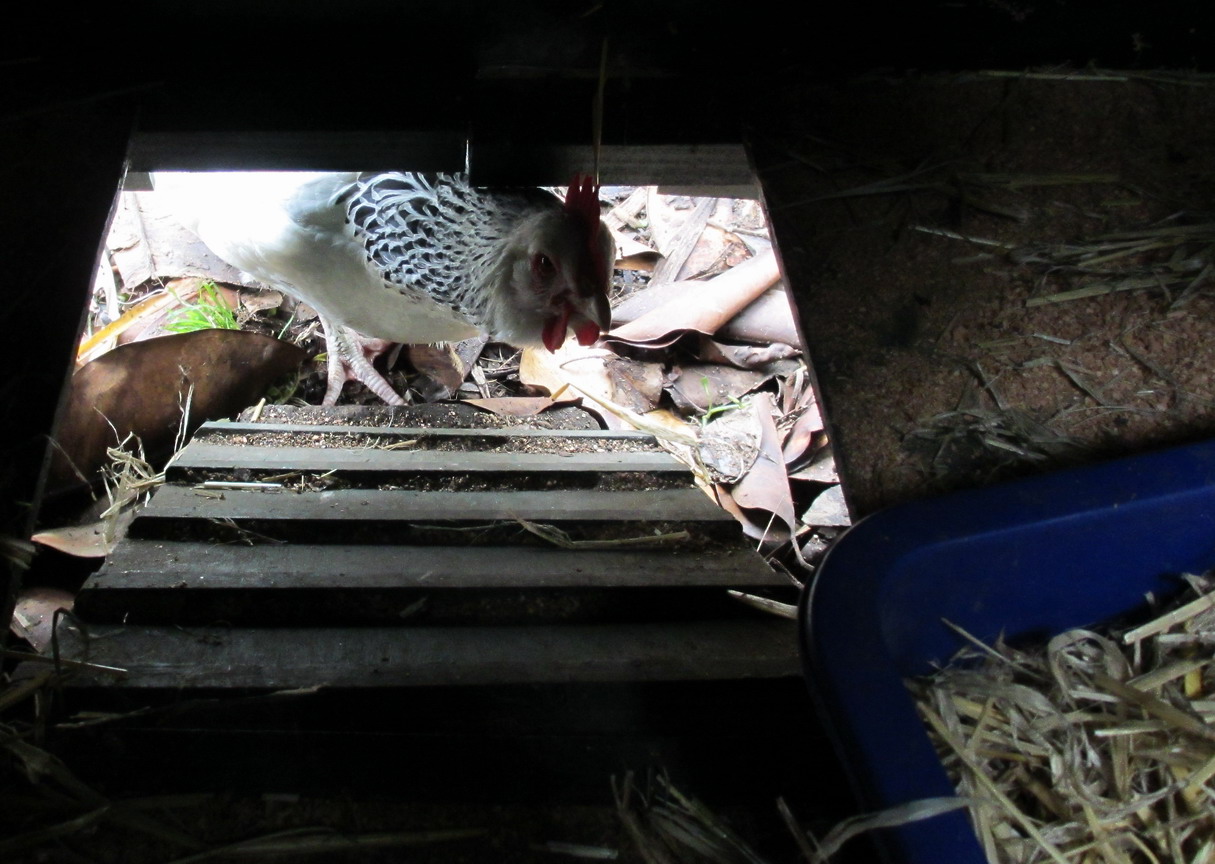
The chalet was designed and built by a carpentry student at Carol’s school. It cost a lot and despite its more modest name is far more upmarket than the (older) palais de poulet where the chooks roost at night. Its hentrance is discreet — a very short ramp underneath that doubles as a trapdoor — and just lately I’ve wondered if they’ve forgotten how to get in. On a few fine days, I’ve gone so far as to open another door, the large one through which I collect the eggs, if there are any.


Leaving it open isn
t practical, given the rain we get in these winter months. And it’s wishful thinking. When I’ve peeked inside the chalet, I’ve seen only a scuffle of the nesting straw where the girls (having perhaps forgotten what it’s for) have scratched around in a desultory search for snacks.

Mid-winter egg.


I expected the same yesterday, so was greatly surprised to discover an egg. It was from Alice the Australorp, I think, though I didn’t see any hen entering confinement (or leaving it).
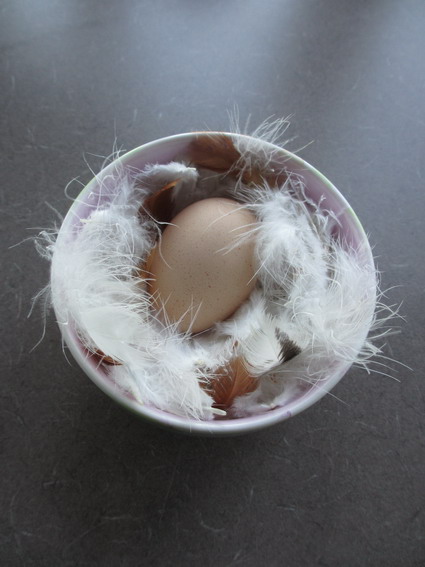
Each chook lays eggs that are slightly different in colour and patterning; this one — light brown with a fine freckling — looks like Alice’s work. The black fluffy feather I later found in the straw may be her signature. What’s more, when hens are in lay, their combs and wattles look more full and red. Hers are glorious right now.

There’s something special about a first egg, and this one made my day. Even more special, however, was the Egg Number One that awaited me a couple of years ago.

My pullets, as they then were, seemed to be eternally on the point of lay. This didn’t give them any discomfort but I was on tenterhooks, feeling like a kid waiting for a Christmas that simply refuses to come. It seemed that what was supposed to happen naturally would require a miracle.


The very first eggs, and a story.
(Illustration by Carol.)
On arriving home one morning after having shoulder surgery and a night in hospital, I was greeted by the sight of two eggs, the first from any member of the flock. Carol had given them pride of place in the kitchen — and egg number one came with a story.

Apparently the hen who laid it was caught short. It arrived in the night, while she was roosting and presumably asleep. The egg fell, and would have broken, but for the small pile of poop below, which gave it a nice soft landing. Next day, on checking the palais de poulet, Carol had found the miracle. It looked like a rugby ball balanced on a kicking tee.


You might wonder if an egg is safe to eat once its shell has been slightly soiled. Well, this didn’t need much of a clean-up. I ate eggs one and two for lunch when I arrived home that day. Each was delicious, and I lived.


Yesterday’s egg arrived just three weeks after the year’s shortest day, winter solstice. It will be interesting to see when the next egg comes along. People with newly productive pullets may be receiving them regularly, but adult hens generally need 14 hours of light to keep on laying. Right now we have fewer than 10 hours.

So this fresh egg was a gift: one I looked for, but unexpected all the same. Perhaps that’s another miracle. Certainly it made me smile for a good long while. 


Tuesday, July 10, 2012

(not the) National Poultry Show

Vanessa the White Leghorn and Emmeline the Light
Sussex
may have missed out on the catwalk, but they
feature as page 100 girls in a new magazine.

Hot Dang! I missed the National Poultry Show, held in Hamilton last weekend. I’d planned to go, but two biggies — Life and Work — got in the way. So I’ve rustled up some props (fallen leaves) with which to hold my own Poultry Show. Here, right at home and with no rosette-claiming characteristics apart from audacity, my chooks strut their stuff.

Oh, and if you find yourself near a branch of New World in the near future, slip in and get a copy of that supermarket’s Real magazine (July–August issue) so you can read my double-page spread on “Backyard Beauties” — keeping chickens. The magazine also has
recipes and other interesting things, such as how to “Make your own Mug Warmer”.

Henemoa and Amelia. As a Rhode Island
Red and a New Hampshire Red, they
are cousins of a kind.
Alice the Australorp (left) is actually more
than twice the size of Victoria the Araucana,
but in her mind, Victoria towers above all.

Saturday, June 9, 2012

Forbidden Fly: Bio-securing a Suburb


“Have any more Queensland fruit flies been found in Avondale since the one a few weeks ago?”, asked a Canadian friend. Lindy is a great gardener and gatherer of things that grow on trees. She’s stayed at my home in that suburb so she was interested to learn that scientists had trapped one of these pest insects nearby.

We don’t usually have Bactrocera tryoni in New Zealand. Females of this species are notorious for injecting their eggs into fruit when it approaches what growers consider to be perfection. On the other hand our tiny, ubiquitous Drosophila fruit fly, from a different family altogether, arrives on a whiff of ferment: its females prefer a slightly past-it squishiness for their nurseries, rendering a less common name — vinegar fly — more appropriate.

Produce that’s infested with Queensland fruit fly larvae can’t be sold and will quickly rot. As Bactrocera tryoni likes more than 100 different kinds of fruit, the visiting Australian (a single male) caused quite a flap. 


Banana skin. Dropped outside
our place during the controls.
Our big new Ministry for Primary Industries responded to the discovery by setting up a “controlled area” of about 1.5km, from which whole fruit or vegetables were not to be moved. When I took a small bag of homegrown feijoas to my parents, who live several suburbs away, Dad asked quizzically if my address was in the zone. Luckily not: the boundary was a few houses away.

People within the zone were asked not to compost their fruit and vegetables. Signs went up on the borders, a lot more traps were installed, and Avondale’s Sunday market was abuzz with officials checking that buyers and sellers knew the rules. Yellow lidded bins were stationed at intervals along local roads for the disposal of produce from the controlled area.

It felt a bit like one of those patriotic wartime campaigns for the home front, and initially it was easy to get excited. But our primary industries people seemed to discourage digging for victory — within the zone, you weren’t supposed to move soil from under fruit trees. (Queensland fruit fly larvae pupate in soil.)


Amelia (New Hampshire Red),
very interested in some guavas.
Just outside the zone, a few more end-of-season feijoas plopped to the ground from our tree, my crabapple crop was ripening, and the chooks were enjoying the odd piece of fresh produce that went their way. I continued my small-scale composting operation.

In case that made me a bad person, I also topped the indoor compost bucket with shrink wrap, and entirely covered any fresh additions to the lidded outdoor bins with stinky chicken manure to repel boarders. I’d already been taking care to collect any fallen feijoas: rats had moved in a while before, and I didn’t want to offer them breakfast as well as bed.

We watched out for invaders in the form of flying machines — colourful ones, 7mm long. Within hours of the announcement about possible fugitive fruit flies, Carol caught one (she was pretty sure) when she was doing the dishes. The half-drowned creature went into secure confinement and my partner rang the hotline, whose responder said someone would come to collect it. They never showed. 


Unwanted: Queensland fruit fly
(Ministry for Primary Industries).


It’s hardly surprising: most of us humans are not even on nodding terms with the many insects in our environs, so our chances of correctly identifying a newcomer are slim. Most insects that are permanent residents don’t do major damage, though Carol’s brother-in-law regards mozzies* as his mortal enemy (the whine of their wingbeats as they approach means “I smell the blood of an English-man”). Perhaps our prisoner was one of those drab little miseries, though Carol has her doubts.

A lone male fruit fly is a bit like the proverbial single swallow, only instead of not making summer, it doesn’t
a) make whoopie,
b) sow its wild oats, or
c) start a dynasty. 
So a fortnight after the fruit fly flurry began, and with no further sign of B. tryoni migrating across the ditch,** the restrictions on Avondale fruit and vege were quietly lifted. 

Two minutes walk from home.
Presumably our government and trading partners were satisfied that no new population of pests was being established, or perhaps the whole thing had been a dummy run. (Army officers hold exercises: why shouldn’t the officers of Ag and Fish?)

It’s a relief. Only a few years ago, some of Auckland was subjected to mass aerial spraying of a product to rid us of another unwanted Aussie, the painted apple moth. And though mass aerial bombardment would not have been undertaken for fruit flies, there would have been changes. 


We would have had to be diligent about collecting fruit from our trees, preferably before it fell. Composting would have been curtailed. A series of chemotherapy treatments may have been the lot of my largely organic garden plot. Distribution of home-grown fruit and vege to folks beyond the Avondale border would probably have come to an abrupt halt. The silvereyes would have found fewer crabapples to eat, and The Good Life would have been a little less so.

Home-grown feijoas, from the last of the
season
s harvest. (Bowl courtesy of Jocelyn;
food styling by Claire.)
*An abbreviation of mosquitoes, used frequently in New Zealand but originally from Australia, even if the insects themselves are our own.
** The ditch is the Tasman Sea between NZ and Oz. It’s pronounced
dutch, if you’re a Kiwi; deech, if you’re an Aussie.

Sources and Interesting Reading

www.fightthefruitfly.org/information.html
www.daff.qld.gov.au/26_17828.htm
Which New Zealand Insect? Andrew Crowe;
New Encyclopedia of Insects and their Allies,
ed Christopher O’Toole (accessed through Oxford Reference Online)

Saturday, June 2, 2012

Crabapples, Late Afternoon, Early Winter


The crabapple trees have been full of fruit for a couple of months now, but until a short time ago all the leaves were green. This week a few turned yellow — overnight, I swear, each affected leaf like a hair that went white in fright.

In the Great Auk, deciduous trees don’t produce an autumn exhibition like Canada’s or even the South Island’s. Still, our relatively slight alteration made me wonder: why do leaves change colour? 

Several answers are at Discovery and a BBC nature blog: the yellow is carotene that’s already in the leaves but it only becomes evident when colder temperatures scare the pants off the green pigment involved with photosynthesis, chlorophyll. The red that’s seen in some trees’ leaves during autumn is more complicated.

These crabapples were planted for privacy a few years back. One has a distinctive lean to the right, though I can’t hold that against it. All three trees beckon me out the bay window of my room. They reach for the sky, and birds spend half the daylight hours in their branches.


Among them are quick little silvereyes. Their dexterity, their olive-green, grey and light tan colouring, and the bright eye-liner indicated by their common names (waxeye and white-eye too), make them very appealing. Here’s one photographed elsewhere by Steve Attwood, in Easter 2011.

Another bird drawn to the crabapples is a greenfinch, perhaps the first in our garden. He’s also small, but looks big and lumberly* beside the silvereyes.

One day I might be quick enough to catch them with my camera. For now, the sole documentary evidence of their presence is a picture of half-eaten fruit. 


*lumberly, adj. Clumsy, cumbrous. OED